

- Turbine load calculations using standard design equations
- DNV RP-0661 compliant site assessments
- IEC-standard power performance testing
Quick Start
Get up and running in minutes
Installation
Install TACT as a Python package
API Reference
Complete API documentation
Examples
See TACT in action
Key Features
Multiple Adjustment Methods
Multiple Adjustment Methods
- Baseline - No adjustment (reference comparison)
- SS-SF - Site-Specific Simple + Filter (recommended)
- SSWS - Site-Specific Wind Speed
- SSWSStd - Site-Specific Wind Speed + Standard Deviation
Industry Standard Validation
Industry Standard Validation
Built-in DNV RP-0661 validation with MRBE/RRMSE metrics and acceptance criteria visualization
Professional Visualizations
Professional Visualizations
Publication-ready plots with DNV acceptance criteria, regression analysis, and comparison charts
Extensible Architecture
Extensible Architecture
Easy-to-use plugin system for adding custom adjustment methods to fit your specific needs
Quick Example
Get started with just a few lines of code:Method Performance Comparison
Example results from one test dataset show performance differences between methods:| Method | MRBE | RRMSE | Approach |
|---|---|---|---|
| SS-SF | 37.8% | 111.1% | Direct TI regression with filtering |
| SSWSStd | 37.7% | 121.6% | Dual WS+SD adjustment |
| SSWS | 92.1% | 188.0% | Wind speed adjustment only |
| Baseline | 90.4% | 183.0% | No adjustment |
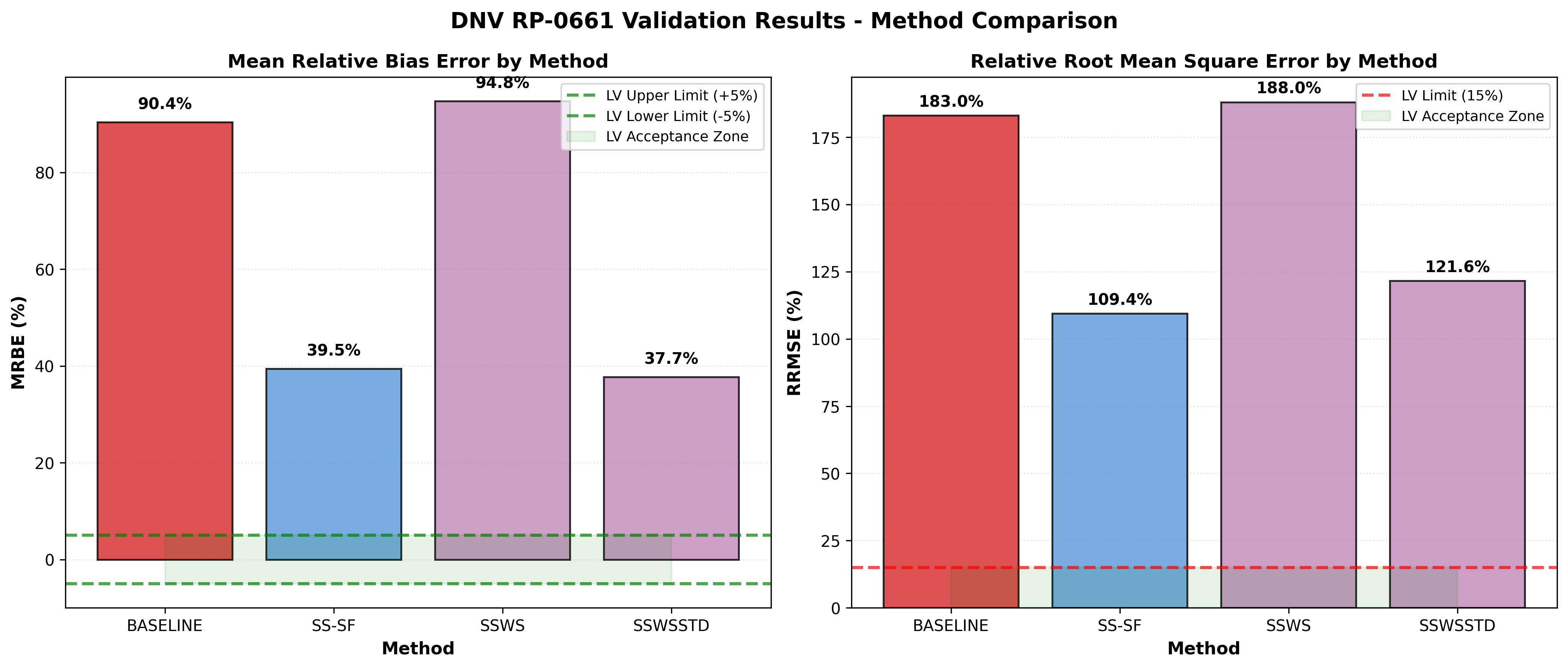
The optimal method depends on your specific dataset. We recommend comparing all methods on your data using
compare_all_methods.py.Next Steps
Install TACT
Set up TACT in your environment
Getting Started
Complete walkthrough tutorial
Import Your Data
Learn how to prepare your data
Need help? Check out our troubleshooting guide or contact support.